Flip the Bottle Over: A Shopper's Cheat Sheet for Reading Supplement Labels Like a Pro
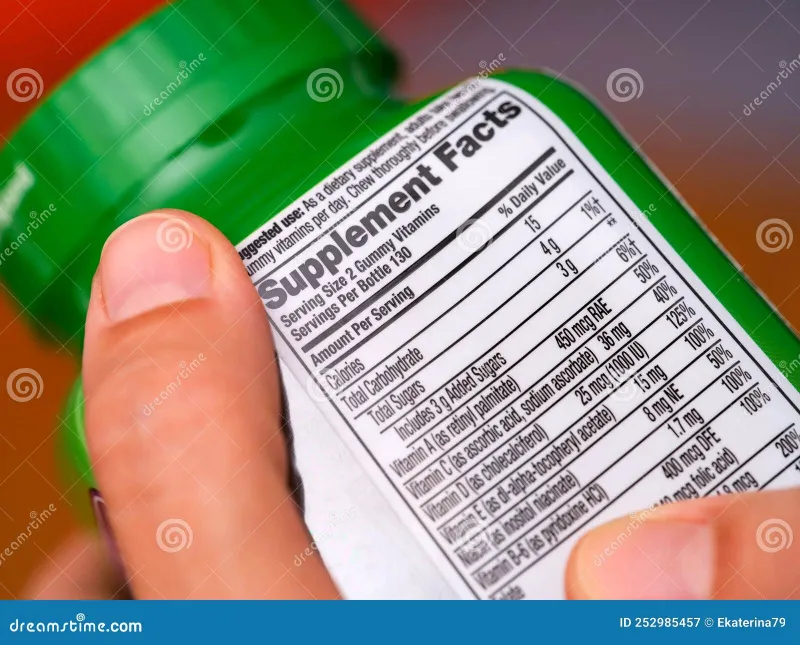
Photo: person reading supplement facts label on vitamin bottle close up, via thumbs.dreamstime.com
You've done it a hundred times. You pick up a bottle, squint at the label, see a wall of scientific-sounding words, and just... trust the marketing. But here's the thing: the back of the bottle tells you everything the front is trying to hide. Once you know what to look for, you can size up any supplement in about 90 seconds. Let's walk through it.
First Stop: The Serving Size Game
Before you look at a single ingredient, check the serving size. Some companies list doses per two or even three capsules to make their numbers look bigger. A product bragging about "1,000 mg of vitamin C" isn't so impressive when the serving is four caplets and you're supposed to take them twice a day.
Also note how many servings are in the container. A $12 bottle with 15 servings costs more per day than a $25 bottle that lasts two months. Basic math, but it's amazing how few shoppers run it.
The Proprietary Blend Red Flag
Here's the single most important trick in your detective toolkit: when you see a phrase like "Power Metabolic Complex" or "Immune Boost Blend" followed by one combined weight — say, 850 mg — that's a proprietary blend. And it's often where quality goes to die.
Why? Because companies aren't required to disclose how much of each ingredient is inside. That means they can pack the blend with cheap fillers like rice flour or tiny amounts of the flashy ingredients listed first, just enough to legally mention them on the label. If ashwagandha is the first ingredient in a 500 mg blend, you might be getting 400 mg of it. If it's listed sixth? You could be getting a sprinkle.
Rule of thumb: Look for labels that spell out individual amounts for every active ingredient. Transparency is expensive, so companies that do it usually have nothing to hide.
Filler Watch: What's Lurking in the "Other Ingredients"
That little line at the bottom of the panel matters more than you'd think. Some excipients are perfectly fine — things like cellulose (plant fiber) or rice bran are harmless and help machines run smoothly during manufacturing.
But keep an eye out for:
- Magnesium stearate in large amounts — used as a flow agent, occasionally criticized for potentially slowing absorption
- Titanium dioxide — a coloring agent that's come under increasing scrutiny
- Artificial colors and sweeteners — unnecessary in a capsule, and a signal the company is cutting corners elsewhere
- Sugar and corn syrup — usually in gummies, which often contain a fraction of the advertised nutrients anyway
A long "other ingredients" list on a product with a short active list is a tell. You're paying for packaging, not nutrition.
Doses: Does the Number Actually Mean Anything?
Here's where a little homework pays off. Look up the commonly studied dose for the star ingredient — for example, most research on omega-3s looks at 1,000–2,000 mg of combined EPA and DHA daily, and curcumin studies typically use 500–1,500 mg with enhanced absorption.
If the label shows 25 mg of an ingredient that's studied at 500 mg, you're buying a fairy tale. It's called "fairy dusting" — adding a token amount of a trendy ingredient so it can live on the front label.
Also check the form of the nutrient. Magnesium oxide is cheap but poorly absorbed; magnesium glycinate or citrate cost more to produce and your body actually uses them. Same story with folate versus methylfolate, or standard turmeric versus bioavailable curcumin extracts. Form matters as much as quantity.
Side by Side: A Tale of Two Labels
Let's put it all together with a hypothetical multivitamin matchup.
Bargain-bin Brenda's Mega Multi ($8.99):
- Serving size: 2 tablets, 30 servings
- "Vita-Energy Blend — 620 mg" with 14 ingredients, none individually dosed
- First ingredients: calcium carbonate, microcrystalline cellulose, glucose
- Contains artificial colors (Blue 2, Red 40)
- Vitamin B12 as cyanocobalamin at 6 mcg
The transparent option ($29.99):
- Serving size: 2 capsules, 30 servings
- Every active ingredient individually listed with exact milligrams
- Chelated minerals, methylated B vitamins
- Short, clean excipient list
- Third-party testing mentioned, with a batch number you can verify
Do the per-day math and the gap shrinks dramatically — and with the second product, you know exactly what you swallowed. That's worth real money.
Third-Party Seals and Other Trust Signals
The FDA doesn't approve supplements before they hit shelves, so independent verification fills the gap. Look for NSF Certified for Sport, USP Verified, or Informed Choice marks. Not every good product carries one, but their presence is a strong positive signal.
Also, scan for a legit manufacturer's address and contact info. A label with only a P.O. box and a stock photo of a lab is telling you something.
Your 90-Second Checklist
Next time you're shopping, run this quick screen:
- Check serving size and servings per container
- Skip anything hiding behind a proprietary blend
- Scan "other ingredients" for junk
- Compare doses against studied amounts
- Look for better-absorbed nutrient forms
- Check for third-party certification
Five of six? You've probably got a keeper. Fewer than three? Put it back on the shelf and keep walking. Your body — and your wallet — will thank you.